
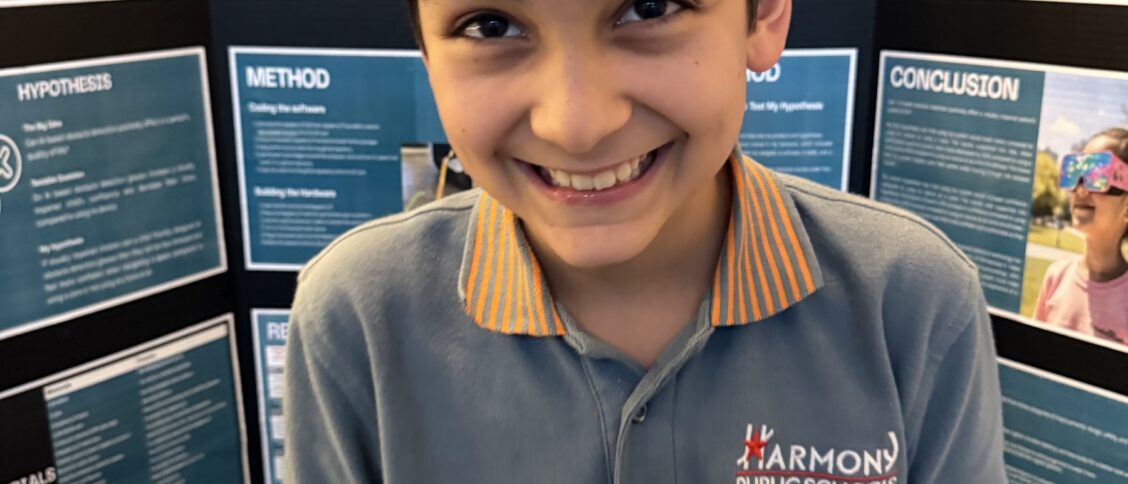
By Lucas Tudor | Grade 5, Harmony School, Texas
My name is Lucas Tudor. I am 11 years old and I go to a Harmony school in Texas. I like coding, building things, and figuring out how stuff works. I am just a normal kid in 5th grade.
But this year I did something I never thought a kid my age could do. I invented a pair of AI-powered glasses to help blind children navigate the world safely. I built the whole thing myself, from writing the code to 3D printing the frames. I won First Place at my school science fair and First Place at the Greater Austin Regional Science & Engineering Fair. I got interviewed on the news. And then I cold-emailed a real CEO and she sponsored my project.
I didn’t do any of this because I’m some kind of genius. I did it because one day I asked myself a question that I couldn’t stop thinking about.
What if you woke up tomorrow and you couldn’t see?
Not just couldn’t see well. Couldn’t see at all. How would you get to school? How would you walk down a hallway without bumping into someone? How would you just be a normal kid when the whole world is designed for people who can see?
I couldn’t get that question out of my head. So I decided to do something about it.
The Problem Nobody Was Solving
According to the CDC, over 7 million people in America are visually impaired. About 6.8% of children under 18 have a diagnosed eye or vision condition. The tools available to help them include canes, guide dogs, GPS apps, and smart glasses. But almost every single one of those tools was designed for adults. They are too heavy, too bulky, and too complicated. A white cane only tells you what is on the ground. It will not warn you about a table at chest height or a door swinging toward your face. Visually impaired children are navigating a world full of obstacles every single day, with tools that were never made for them.
That is the problem. And nobody was fixing it.
The 45 Minutes That Changed Everything
Before I built anything, I needed to feel the problem myself. So I blindfolded myself, spun around in my own house, and tried to walk to our Christmas tree. It took me 45 minutes. In my own house, where I know every single room. I bumped into walls. I bumped into furniture. I grabbed something off the floor to use as a cane. It turned out to be a model Santa from our Christmas decorations.
The whole time I felt scared, stressed, frustrated, and trapped. And something I did not expect at all: lonely. Even with my parents right there, I felt completely isolated. That was just 45 minutes. For visually impaired children, that is every single day.
What I Built: A Eyes
A Eyes is a pair of AI-powered obstacle detection glasses built specifically for visually impaired children. I used a Raspberry Pi Zero 2 by Raspberry Pi, connected to a 12-megapixel Arducam wide-angle camera by Arducam. I wrote Python code using PyCharm by JetBrains, stored in a GitHub repository, that runs computer vision software to detect obstacles. When the glasses detect something, they send a spoken alert through Apple AirPods via Bluetooth. I 3D printed fun colorful frames so kids would actually want to wear them, all powered by a portable battery pack.
I built it. Coded it. Designed it. Me. In 5th grade.
The Results
I tested A Eyes with three child volunteers on a backyard obstacle course. Each child completed the course four ways: blindfolded with no device, blindfolded with a cane, blindfolded with A Eyes, and fully sighted. I measured their stress and confidence after each attempt on a scale of 1 to 10.
Stress scores (lower is better): No device: 8.1. Cane: 6.0. A Eyes: 3.22. Fully sighted: 0.
Confidence scores (higher is better): No device: 2.44. Cane: 4.66. A Eyes: 7.77. Fully sighted: 10.
A Eyes made kids 62% more confident and 62% less stressed compared to no device, and 37% more confident and 50% less stressed compared to a cane. The glasses worked.
First Place, A CEO, and What Comes Next
A Eyes won First Place at my school science fair and First Place at GARSEF. A news team came to interview me about it. But I still had a problem to solve: my test participants wanted to mute the voice alerts while talking, and pressing a button when you cannot see is really hard.
So I started thinking about EEG technology, which reads brain signals so kids could control A Eyes with their mind instead. The problem was that EEG headsets cost hundreds of dollars and my allowance is $9 a week.
So I wrote directly to the CEO of Emotiv, Tan Le. I explained who I was, what I built, and what I wanted to do next. She wrote back and said yes. Emotiv fully sponsored an Emotiv MN8 for me, granted me Device Lifetime Access, gave me full developer resources, and invited me to my first ever real business meeting with their team.
A real company believed in an 11-year-old kid. Because I asked.
Help Me Take A Eyes Further
To reach visually impaired children everywhere I need partners in assistive technology, AI, hardware, and accessibility. You can sponsor components, fund testing with real visually impaired children, or provide mentorship.
Those kids are out there right now, navigating the world without tools made for them. Let’s change that together.


